Thursday, April 2, 2009

Hi everyone, it’s been a long time, as usual, since I’ve sat down and written a decent entry. It’s absolutely mind-boggling to me how I’ve managed to get a schedule that leaves basically no free time during the week and only a little on the weekend (if I’m not traveling). I'm putting a lot of pictures up in this entry that really have little to do with what I wrote since I wrote this at home and my pictures are rather random.

[Here's Turtle. She's too fast for her own good. Oh and below that's the cat nursing the dog. Yup. You saw it here first.]


So I guess I’ll give some updates by area:

Sad News:
The Peace Corps community got some sad news a couple weeks ago. A second year education volunteer was killed in Benin. She was my age and basically living my life which is why it’s so disconcerting for me to hear the news. She was found dead in front of her house; she'd been sleeping outside. My condolences to the family and friends of Katie – que son âme se repose en paix.

Also the Madagascar program recently got evacuated. The military was no longer supporting the government and shortly after there was a coup d’etat. All the one hundred and something volunteers got evacuated safely and the training group that was literally just about to depart from the States to go to Madagascar got their program cancelled. Katherine was in that training group and they all got reassigned across Africa – she’ll be going to Mauritania to do forestry work instead. Not quite the same gig as in Madagascar but there’s something so beautiful about living where people really have it rough - I don’t mean like war-torn areas – I mean like in the desert. I hope she ends up in a good place and can help save the world from deforestation. I know she’ll do great!

[It's food season! (The no-food season is when it's raining and everything's growing). This is about what I can get for $1! Basically I have become a vegetable eating machine.]

Good News:
The Lycée I live next to and I collaborated to put together a Peace Corps Partnership Proposal for a big reforestation project at the school. Peace Corps itself doesn’t give us money to fund project since the vast majority of our work is meant to not involve funding, and shouldn’t for that matter. But there are certain cases where you can still work within the philosophy of the Peace Corps with funding to help. That’s what Peace Corps Partnership does. It’s a program to match potential projects with donors in America who want to help out a community that’s motivated to get a project going. In order to apply you need a minimum contribution of 25% from the community. The projects get posted on the Peace Corps website and anyone can donate. I was so surprised to find that in less than 2 weeks of my project going on the web it was fully funded! We had asked for almost $2000 and all but $50 dollars given by my parents (thank you!) was given by the Returned Peace Corps Volunteers of Madison! We learned about this group when we were learning about Peace Corps Partnership. I was convinced that the rainy season would come before the money would, making the project unfeasible for this year – but we have been saved! Now to figure out how to thank them.

To make the project fit in with the philosophy of the Peace Corps, we’re making it as student-run as possible and as low-budget as possible. We’ve chosen native tree species that are not often eaten by animals and found price-cutting strategies to keep costs down (using empty discarded water bags instead of buying seedling bags for example). We’ll also bring in a local expert to train the teachers who will train the students in how to grow seedlings, saplings and how to plant trees and take care of them. Hopefully by July we’ll be able to put over a thousand trees in the ground, which is pretty barren right now. As I said in the project proposal, this particular area of Bagré is in a river valley and should be full of trees, but the tree growth is really very sparse, and I hope that the whole community can learn from the example of the school! I’ll send updates and pictures when I can or when we’ve actually accomplished something.

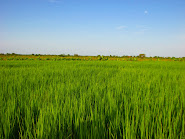
[Andrea came to visit me! And she's Taiwanese like the Taiwanese members of the NGO in my village who work with the rice fields. Here we are visiting some rice.]

School:
We just finished our second trimester for the year and are enjoying spring break. And unlike breaks in America where even though you’re on vacation you have 354232 things to do or 4434 places to go and don’t actually end up relaxing, I am extremely relaxed. I have basically nothing to do and am enjoying 1.5 weeks off with the dog, cat, Moussa and the fan. For some reason, the trimesters get shorter from the first to the third, so that the third trimester that’s coming up won’t even be 2 months. Nothing really drastic to report at school, other than, like last year at this time, there’s no more money. The teachers’ base salary still comes from the state but all the hours they work on top of that is for free for now. I’ve gotten really good at all that by-hand grade tabulation stuff now. It really works out for the best if you grab a couple of your best students and make them help you out with some of the busy work (i.e. someone writes rank on the board while you call out averages).

I’m still teaching life skills to the ninth grade. But to tell you the truth, I have not figured out how to manage the boys. I also do extra-help math class with them, but at least in math I clearly have the upper hand and they are struggling to keep their heads above water which limits the amount of cocky, annoying, disruptive behavior they give me in class. So, being as fed up as I am, I’ve just started asking the boys to leave and working with the girls. There’s enough girl-focused material anyway that it can’t hurt. It’s too bad I can’t manage the boys but I attribute it to two things: 1) the class size is 75 students and 2) the boys ages range from 16-22 which is hard to work with even if there were 3 of them. Anyway, the girls don’t mind getting extra attention (there’s only about 20 of them).

[Here's Moussa relaxing in my yard with one of Barak Obama's books (thank you Addie!).]

Actually I made a really funny French mistake for the first time in a while (not that I don’t make plenty of mistakes but they’re not usually that funny) when I was asking the boys to leave the other day. A few were hanging back and told me that they wanted to stay and even though they were the good students I had to make them leave anyway which I kind of felt bad about. One of them gave me the reason “But teacher, you’re forgetting that there are two sexes, not just one.” What I wanted to say to him was that “No I haven’t forgotten, it’s just that there’s a problem with the male sex” but what I said instead would be best translated as “No I haven’t forgotten, but there’s a problem with your penis!” (sexe means gender and genitals and I didn’t use the you plural I used the you singular so it was like I was telling him personally that there was a problem with his penis). Ooops. The class loved it.

One of the reasons I’ve been asked to do this extra-help math class is because the math teacher we have is, by anyone’s standards of teaching, horrible. He’s new this year. Last year two of our teachers were (only partially their fault) victim to one of the state’s harsh lashing-outs against corruption. I’ll explain: at the end of each school year, there are the national exams that the 5th, 9th, and 12th grades have to take. They are written and taken at the school that the kids attend. To avoid problems, they assign teachers to grade the tests at a different school. Some of our teachers were sent down to Bittou, half way between here and the Togo boarder, and that’s where the problems started. Before the grading started, they were approached by a superior and asked to take money (10,000 F cfa ~ $20) to change the grades of some students’ tests. The woman refused. The man fought but finally took the money to get the person off his back but said he wouldn’t change the grades. Later it was discovered (someone else ratted the guy out) that this had been going on and the two colleagues from my school got punished for not ratting the corrupter out themselves. That’s right: even the woman, who refused, got punished. The man, I can understand him needing to get a slap on the wrist, but what they did instead was just way to harsh in the opinion of even the people here. They were both stripped of their jobs and their teaching licenses. That means that not only are they unemployed but they are no longer able to ever work again as teachers which is really serious since it is what they have been spending all of their education on up until that point. It’s not so easy to switch jobs here as it is in America because of the specialized training needed to apply for so many jobs. The man also had to serve a month in prison, and I assure you that the prisons here are not like the prisons where I’m from.

[Here's me and my 7th grade class!]

So we got replacements, be it over a month after the new school year started, but we got them. We were a little surprised at how easily we got a replacement for the former math/physical science teacher because they are by all accounts the most rare kind of teacher. But no, the state sent a math/PS teacher from Garango on the double and we thought we were saved. We were wrong. The new teacher was one of those people that from the first minute you met him, you knew he was probably going to be problems. Coffee, tea, beer, cigarettes, anything stimulating/mind-altering he could get his hands on he took, even if it was between classes. And he is a very small person – small in build and skinny – with a huge inferiority complex, making even relationships with other colleagues challenging. We thought he had been sent here by choice, since rumor has it that he knocked up one of the 7th graders here last year and maybe he wanted to be a father, but no, it seems that Garango was trying to get rid of him.

Teaching math and physical sciences is not a small thing. I means that you’re holding two of the most important and difficult classes in the exam year, 9th grade, and based on how well you do your job and how well the students do theirs, you either have a high success rate or a low one at the end of the year. So when we learned that the new teacher was not just not teaching well but verbally abusing the students, we didn’t know what to do. His general teaching style is to rush through lessons, giving too difficult and abstract examples and not EVER allowing a student to ask a question. Ok I guess he would allow a student to ask a question, but the consequences that the student would suffer because of the question, no matter what the question, would make him not ask it in the first place. What would he do, you ask? Anything, well first of course he would insult the student for being so dumb to ask such a question, and then either send the student outside or take points off of his next grade or something equally ridiculous. This turns his classes into silent lecture halls, where even the misbehaved boys I can’t handle don’t speak. He calls them dogs (very insulting here), tells them they’re dirty, tells them they’re idiots and that there are students in this country who deserve him but he’s stuck here wasting his time on students that vaut rien (are worthless). Sometimes he’ll come to class and just sit there for 2 hours and stare at them, not saying a word. Sometimes he’ll come to class, drunk, and set up some sort of evaluation for the class where everyone is doomed to fail and most people will be humiliated. All in all we realized that almost no one was passing his classes and that if his grades were an accurate reflection of how well they master the material then no one would pass the national exam either.

Why doesn’t my headmaster fire him? He can’t – teachers are assigned by the state and the headmaster has no more ability to fire him or tell him how to teach than I do. So lacking any other solution, and not being able to confront the teacher, I was told to start doing extra-help classes 2 hours a week. What a mess. Really.

CSPS (Health Clinic):
I started volunteering with the village clinic and I’m finally getting along with my boss. At first, she was really cold and strange and I just thought maybe this was because everyone says she’s kind of cold and strange in general but then it became very clear that she was not very comfortable with my being there. Some days she would barely greet me (which almost a slap in the face here – I take that back – to purposely not greet someone IS a slap in the face). I don’t know, maybe she though I was there to judge her or criticize her or be some sort of undercover inspector or something or maybe she just has really low self-confidence. Anyway I tried my best to play a little bit dumb, like I didn’t have 5 more years of schooling than her, and it worked out for the best. I feel accepted there now. Anyway she’s getting married in a week so she’s in a good mood.

Basically we weigh babies and give them vaccines. Babies from 1-3 years should come in once a month and get put in these sacks and hung like meat from a standing scale and we weigh and record their weights. If mothers do this regularly then they can see if their baby is putting on weight properly or, as happens here sometimes, is losing weight and how much. Getting mothers to come in regularly is practically impossible even if everyone involved wants it to happen. The babies hate it – that feeling of being suspended and often cry so much and flail around so much that getting an accurate weighing is practically impossible too. We try. The maternity part of the clinic is one room with benches along the sides of the room and on Tuesdays and Thursdays when the weighing happens the room gets stuffed so full of women that there’s a crowd standing outside the door and women lining all the walls with their breasts all hanging out and babies everywhere. African women often talk very loudly when they are in a heated conversation, even if it is just about the price of tomatoes, and between the heat and the volume, it’s all a lot to get used to.

[This is one of the life skills activities I did with the ninth grade. You're not going to get that much out of the picture unless you can read French or have a lot of time and a dictionary. We talked about gender roles how they vary by culture. I asked them to put each of the words on the cards into one of three columns on the board according to the values of their culture: Man, Woman, or both. They cards ranged from things like power, asking for sex, sweeping, digging graves, cooking etc. Then we did the whole activity again but this time according to who could physically do what (logically everything except giving birth ends up in the both column). Then for their amusement I did the activity myself, showing them my culture. If you can actually read French or want to try, click on the image and have a look at what these kids see as their culture's gender roles.]

One day I came into the clinic to tell the women I weigh babies with that I wouldn’t be there the following week and I found the room practically empty with only 3 women sitting there. I knew one and sat beside her. I saw no signs of the nurse but I was picking up strange words in the Mooré conversation I was trying to eavesdrop on next to me. They were talking like someone was giving birth but I saw no evidence of that at all. Then after a few minutes a very old woman came out and said it was a boy. Everyone cheered. WHAT?!? I thought – how could someone have just given birth in the room over with the door open and I didn’t even know? The old woman reappeared with the baby and took him to the next room. Less than 15 minutes later the mother appeared – a Fulani girl who couldn’t be older than 16. She walked alone to the room where her baby was and I pretended not to be as shocked as I was inside. What does the birthing room look like, you ask? It’s actually just a metal and plastic cot that’s on the far side of the nurse’s office with a curtain that you can draw between her desk and the cot. One window. No running water (in the whole clinic actually).


House:
I got electricity! I was so sad a couple months ago when I heard that the lycée was going to get partial electricity after all before I left but that my house was no longer being made a priority so I wouldn’t get to enjoy any light, Priority was given to the headmaster, of course, followed by my other direct neighbors to the left and behind. Not all the houses would be electrified because of money, of course, what else. The cost to put in the wires and light bulbs for each house runs about $300 so the school budget could only afford three houses this year. They also managed to electrify 3 classrooms and the administration building. One step at a time I guess. Anyway, after a couple weeks I had pretty much dealt with not having electricity, since I had made it over a year and a half without it and was happy it wasn’t a big deal to finish out my service in the dark. I at least could be sure that it would probably be the only time in my life that I would have to live without light. It did look a little ridiculous though when you looked at the school housing because there were three houses electrified and then mine in the middle of them, in the dark. Raised a lot of questions.

[This is the bandit cat. Could his ears be any bigger?]

Then one night Danny caught me as I was walking Turtle behind the Proviseur’s house one night. He said he had a secret, and that I couldn’t tell anyone. I thought he was just going to ask me for something so I kind of blew him off but he seemed excited so I let him talk. “If God is great, then you will have electricity tomorrow,” he said, grinning from ear to ear. I grabbed his wrist and dragged him 25 feet more away from the house. “What do you mean if God is great, what does God have to do with my getting electricity; what are you talking about?” I asked. He explained that the Proviseur had just gone to market and gotten one big light bulb, one socket, and the other related materials needed to install partial electricity in my house. “But they said there was no money!” I told him, convinced Danny had no idea what he was talking about. Actually he did. They were not going to give me fuil electricity with my own meter. They were just going to connect a wire from the headmaster’s house to mine, as if they were taking electricity from a house to a shed, and do enough work so that I could have one light bulb and one socket.

Well it is Burkina Faso, after all, and what with finding the electrician, making an appointment, having him blow off the appointment, and then finally show up, it took more like 2 weeks than 1 day, but who’s counting. Moussa saw the sunset approaching the day of the appointment, and saw that no work had been done to prepare the ground for the line that would have to cross the lawn between our houses, so he took a pick axe and started digging. Danny immediately relieved him but with in 10 minutes Danny showed us his bleeding palms and admitted it was his first time using a pickaxe and he didn’t know how to do it without hurting himself. Moussa took back the axe and finished the work just in time for it to get pitch dark and for the electricians to finish their work inside. The light is long, about 4ft. and provides enough light to work anywhere in the living room. I bought a surge protector and so now I can plug in as much as I want! I still forget often that I have light, especially when I get home after dark. The reflex to turn on the flashlight on my cellphone wins out and I stumble around my house for a few minutes before realizing that if the neighbors could see me they would be laughing because I’d forgotten about the light switch. Unfortunately though light allows me to work later, I don’t get that much more time because little did I know it but by about 10 pm the mosquitoes in the house are actually so bad that even if you’re wearing bug repellant and long pants you won’t be able to think straight. Best to go to bed at 9 like I always did, safe under my mosquito net.

All of this work should have already been done, I should add. Total electrification was in the building plans and everything. But like with the courtyard walls that are actually just chicken wire fences or the indoor showers that are actually outdoors or the equipped laboratory that is bare and unfinished, there is often a difference between what is promised and what is done. The difference of course ends up as spare change in the pocket of the builder.

[This is a bad picture of what I think is a Great Blue Heron in our resevoir. Am I wrong?]

The best consequence of electricity at a school is without a doubt the fact that students now have a lighted place to study in the evenings. For some their houses have light, for most they don’t, but either way it’s nice to see that students are able to come and have a quiet, focused place to work at night. I ask myself when my school out in the sticks will ever get electricity; maybe in 30 years. It was relatively easy to get electricity to the lycée because the electricity that is produced by the hydroelectric dam that goes towards Ouaga travels down the main road of Bagré for a while, directly passing the lycée. That electricity gets diverted and cuts across the country side away from the road before my school, and of course, before the actual village of Bagré. It’s amazing that a village whose river produces a good chunk of electricity for this country doesn’t even get electrified itself. The fact that a school 1 km away from the source of the electricity, directly next to where the electricity passes, took over 2 years to get partial electricity is just ridiculous.

Cat:
Mice pretty much took over my house. I’d buy tomatoes and wake up and find half of them gone. Not like 3 out of 6 gone but like one half of each of the 6 tomatoes gone. They started running around the house as if I didn’t really live there, sure that nothing was going to get them. I’d find about a nest a week, in a box, under my stove, in a hole dug in the wall, and have to fish out the screaming babies and throw them outside. The ands of course do the same thing since Africa ants and America ants are not the same thing. There’s this species that is pretty large, I’d say each ant is about 1 centimeter long, their head is black but the rest of their body is amber and they are incredibly organized. When they find out that I’ve left some tea in a cup on the counter over night I wake up to find about 300 ants inside the cup drinking. They’re strong enough that they can carry away baby mice and they do so regularly. Being mice and not cats, killing the baby is another thing. They do the only thing they can do which is bite the baby so much that it bleeds to death and then carry it away to the nest.

They also ate into pretty much everything else – some things I’d never expect mice to bite into: my clothes, my sponge, my books, my bed frame, my mats, and my chairs. I decided it was time to get a cat – and so came Jack – the cat I put up a picture of a couple weeks ago. He’s pretty useless with mice right now at his age but nonetheless they all moved out as soon as they smelled cat in the house. He’s starting to catch lizards though so I hope that pretty soon if I go away for the weekend he’ll be able to feed himself alright.

One thing that’s pretty strange about him is that he nurses the dog. I mean the dog has no milk or anything, but I guess he likes the feeling, that’s all. The dog and he didn’t get along at all in the beginning but now they think they are mother and son. They play together and eat together and sleep together even though Turtle’s a giant next to him.

COS conference:

[This is me and one of my bestest buddies Caleb (though we never see each other because he practically lives in Niger) at our COS party! Go us!]

Just a couple weeks ago we had our COS (Close of Service) Conference. COS conference doesn’t mark the end of service, but is rather the final training you receive during your service about 5-6 months before the actual close of service. We were taught all sorts of things about what it’s like going back to America, reintegration, perks of being in the Peace Corps, all the endless administrative forms to file, how to find a job, how to interview, how to be normal again etc. There were 16 of us there (we started as 29). All in all we all found it to be a pretty traumatic experience. We were told that while most people manage to reintegrate (yes they actually said most not all), basically everyone has difficulty doing so and that the readjustment period usually lasts from 3 months to a year. Most people actually report that going back is harder than coming ever was. But they told us coping strategies – you know – like don’t go into Big Y the first week you’re home. The CD (Country Director) said about half of us ended up in his office in tears during the week. But actually looking back on it, I thought it was by far the best training conference we’ve had as far as how informative and how useful that information is.

[This is me and Danny's mom (my left), dad (my right) and his dad's other wife (left of the dad).]

One thing I worry about quite honestly is my English. While I’m probably justified in saying that I’m fluent in French now, my English has certainly taken a hit. Let’s hope that once I’m back I can keep the French fluency and get my English back too and that every time I see a black person in America I don’t start speaking French.

As far my post-Peace Corps plan goes, I guess it’s not that bad. I mean some people really have no idea at all what they’re going to do – or what they want to do for that matter – when they get back. It’s really true that the freedom you have after being a Peace Corps volunteer is really unmatched. You can apply the skills you learned during service here to pretty much any job – kind of like being a physics major but much more so.

[This is me and my neighbors' younger kids. Irene (e-ren) and Anicet (ah-nee-say) in my living room. Daniel's camera skills are unparalleled I must say.]

As for me, I’ve spent lots of long hours reading and listening and researching, trying to understand the difference between the aspects of training/a career in advanced practice nursing and training/a career as a doctor and which one I want to pursue. As much as financially I didn’t want it to be the answer, I’ve come to the conclusion that I really do want to pursue becoming a doctor. Eh, Peace Corps has really shown me that there’s always a solution – and I’m sure it’ll work out one way or another. And I’m not even saying that with a knot in my stomach like an American would – I really believe it now. Either way: 1 year of getting ready for med school + 1 year of applying and getting rejected + 1 year of applying and getting accepted will probably mean 3 years till I go which means that in the mean time I’ll be working doing who knows what. Ça va aller! For the time being, I’ve submitted an application to the UConn Post-Bac Program, which is for people like me looking to get ready to apply to med school.

My official COS (again, that’s Close of Service) date is July 29. I’ll be COSing with Marty and Caleb and Julia. My COS date is not the day I’m leaving the country – it’s just the day that I end my service. I’ll be coming home mid or late August or the beginning of September – depending on what happens with this Uconn Program and what not.

Thursday, March 19, 2009


Sorry I don't have time for a real post but I just wanted to show you a picture of my new kitten! I got him about a month ago and he's here to kill the mice that are taking over my house. Oh, and that's a guinea hen head, his pacifier. His name is Jack (jakuma means cat in Dioula).

Saturday, January 3, 2009

Christmas in Bagré / New Year's in Toussiana

Happy (late) holidays everyone. Last holiday season I spent on the coast of Ghana but this year I did it up village style. Christmas was chez moi in Bagré and then after a stop over in Ouaga we continued on south to Toussiana to celebrate New Year's and see the family there.

For Christmas I decided to get a sheep. Usually functionnaires flee the village to go to the cities during school breaks but once I started talking about a sheep, I noticed that people's travel plans started after Christmas instead of before. Buying a sheep, while a fairly common thing in village, is not that easy to do as a white person. Naturally the thing to do was to delegate the task to someone else. So first we tried to get one through a Peul (the ethnicity that raises livestock) high school student at the lycée. They kept saying that the sheep was coming, the sheep was coming, but no sheep. Finally, one day late and at night, the students showed up on a moto with a sheep in their arms. I'd saved up 60 dollars for the sheep, so it should have been a real big one. The sheep they'd brought was more like a 35 dollar sheep, but they were asking 50. After much questioning we found out that the students had told the sheep's owner that it was professors who wanted to buy a sheep, which explains why the price was so high. We told them to take their sheep and go. And they did.

The next strategy was to ask the old man who is the watchman for the school to do it for me. A real villageois, the man doesn't speak any French and wears a long boubou and muslim cap everyday. He rides a bike around and often puts his youngest baby in the basket in front of the bike. I told him in broken Mooré that I wanted to buy a sheep, how much money I had, and the day we needed it by. I asked if he could got to market the following day and he said that he couldn't - that he needed to travel. I felt silly because it hadn't occurred to me that the old man did things like travel. Anyway, the following market day, which was Christmas Eve, he went to market with a colleague and i wished them good luck (may god let them find a good sheep). I didn't see them for over 2 hours. I was convinced no one had brought sheep to market that day and that Christmas would be sheep-less but just as I was giving up hope they came barreling into the school yard on Oued's moto with the guardian holding the sheep on the back. He was beautiful! Cost: $55. He's pictured there below with me and Moussa's brother Brama who was visiting from the Cote d'Ivoire, which is the other big news. Brama, and all of Moussa's direct family, lives on the Coast of the Ivory Coast and while all the kids are Burkinabé, they've never been to their own country. So Brama, at the age of 24, took a tour of his country and got to see where his people come from.

He's the only one of us who actually says his 5 daily prayers, so he was the one to slaughter the sheep. I thought that coming to a place where one day animals are alive and the next they are on your plate would make me either like playing with animals less or like eating them less.


Friday, December 26, 2008

Happy Holidays everyone. Here are pics from Tabaski and the forced vacation in Beguedo. An and Moussa and I played lots of scrabble, ate lots of sheep and had a good week of relaxation.


Sorry it’s been so long guys – being on the internet just doesn’t come easily here and when I do get online, there seem to be other things that need to get done.

Wow the election was exciting, wasn’t it? I don’t know how it was at home (everyone said it was a true drama) but here people followed along with anticipation and hope. I voted via an Absentee Ballot and the help of the diplomatic pouch, for yes, Barack Obama, like there was any question. As the days got closer, everyone seemed to be counting down – even BBC wouldn’t stop talking about it – hell, even my 7th graders wouldn’t stop talking about it. BBC World Service focus on Africa has become somewhat like listening to CNN without the flash of the TV. They talk about America about half the time and about the rest of the world mixed with random stories and amusement for the rest of the time. The amount of emphasis placed on America and what our government’s doing is really remarkable. Really takes getting out of the country to see just how much the rest of the world follows what’s going on chez nous. Not like they have a choice.

The day before the election I took a 2 hr. break from math with my 7th graders and gave them election info 101. Unlike how little American students learn about Africa in middle school, 7th graders here spend their whole year in Geography studying America. Some of them have televisions but 95% of them are living in mud huts without TV so while they all seemed to know about Barack (how couldn’t you even with a short wave radio) – they were a little mixed up about who stood for what and why. So I taught them about Democrats and Republicans, some generalities of both parties, taught them which party Bush was from, which party Clinton was from and then opened up the floor for questions. Got ALL SORTS of questions like:

Who is Bill Clinton?
Who is his wife?
Can a woman be president?
Who is Osama Bin Laden?
Does Osama Bin Laden exist?
Is he dead?
Why does the US want to find him?
Why did the US start a war in Iraq?
Why won’t you leave Iraq?
Who attacked the US in 2001?
Why does America like war so much?
What are you doing in Afganistan?
How much money does the president have?
How much does a functionnaire (someone who works for the state like a teacher) make in the US?
How much does someone who washes dishes make in America?
How much does a sheep cost in America?
Does it snow a lot there?
How much do tapettes (flipflops) cost there?
How much does benga (beans and rice) cost there?
Do you have mangoes there?
What is the economic crisis?
Why do people say it’s the US’s fault?
Is Barack really black? (Here they would say no, he’s not, actually – he’s a mélange).
Is his wife black?
How many black people are there in America?
How much does it cost to fly there?
etc.

And then election night: I followed BBC until I couldn’t stand to even look at another test I had to correct and it became clear that we wouldn’t even have the East Coast’s results until after midnight. BBC cuts out for me after a certain hour and I’d made arrangements with my parents to call me every hourish after midnight with any results they might have. At about 2, Addie called me and said that we don’t know anything really and that she’d call me back at 4. At 3 I started getting text messages from people asking if anything was for sure and at 4 I started getting phone calls with people trying to tell me that Barack had won. Some were not so effective, like Tiana’s:
“Elizabeth,” said as if to a kindergartener since I was half asleep, “I just wanted to tell you – click” The network cut out. But that was enough. I reached around the bed for the radio and found BBC and started replying to the messages and calls. McCain was giving his concession speech. Then Obama spoke and because the cell phone’s so cheap in the middle of the night and the early morning, I spent the rest of the time before school talking about what had happened.

Got to school and told my 7th graders and they CHEERED like he was a celebrity and their president. Amazing. All the day people shook my hand and congratulated me. Many congratulated me in they way one would if I had had a baby or passed a really important test, a long handshake with touching of the foreheads 4 times, side to side. My director took me out for a coke and a chicken to celebrate. Doesn’t beat that.

In other news the Harmattan has arrived! Not my favorite time of year, but sure beats the hot season. The Harmattan is the hot dry wind that blows off the Sahara and dries out EVERYTHING. I don’t mean like a breeze, I mean like a constant wind all day. I bike to school and (if only candid camera were there) the head on wind and the sandy roads slow me down so much sometimes that I just stop. Stop and then laugh at myself.

The Taiwanese, in preparation for the Ambassador’s visit, scraped the main roads in the village with their big machines so that there wouldn’t be so many holes and giant rocks as you see after the rainy season and it would make the visit nicer for the Ambassador but unfortunately it destroyed the roads. They just turned to dust. No not sand – DUST. Now a moto makes a dust cloud that a car would have made before and my dog makes a dust cloud like a moto used to make. A car or a big truck lifts so much dust into the air that it settles over the surrounding fields like morning fog. They promised to fix the roads and lay down new dirt but it’s slow going. Meanwhile I have the first sinus infection of my life and am on antibiotics thanks to the dust. Turtle coughs and so do the chickens.

Turtle followed me to school every day and then one day she just stopped. She follows me to this invisible line just before market and then just stops. Maybe she realized she doesn’t have to follow me or something. Strange. Just one day up and stopped. She’s overall well. Energetic as a 6 month old puppy and runs like the wind. Her pregnancy was in fact a fake. Her stomach shrank and her breasts got tiny again. But now there’s a new problem. I’m not a doctor but it seems like her uterus is prolapsed. Her cervix is visible from the outside. I don’t know how much worse it will get and there’s nothing to do but wait and see because there’s really nothing to do. She doesn’t seem to notice. She terrorizes the neighborhood dogs and runs circles around them.

Today I saw a strange African thing. Once in a while someone like this comes through town: a man with about 15 dogs following him. They say that some people have the power to get dogs to do this. They find someone who wants to get rid of their dog or just a stray dog, give them this certain food and then the dog will follow them. A man came through town like that today. Strange.

We also had a féticheur (not sure how to translate that – like someone who practices traditional medicine / fetish / magic stuff) come through town and he gathered a crowd all day long. Little bags filled with different powders, parts of animals (heads, bones, tails, furs, teeth) and all sorts of rings with different powers, mostly protective, all presented in a very alluring/entertaining way. I think part of the reason non-africans have such a hard time believing the traditional medicine type stuff is because it always seems to be next to black magic or other things that really don’t have to have anything to do with traditional healing. I’m determined to see some magic before I leave.

You all following the mess in the DRC?

Two Burkina Peace Corps were very lucky the other day when their bus slammed into a tree, replacing the driver’s seat with the tree trunk. They were evacuated to South Africa (not exactly right around the corner is it?) for medical care and are fine. We had a horrible accident on Saturday that made it onto BBC actually. I heard “In Burkina Faso …” and I knew that if Burkina had made it on the news it couldn’t be anything good. A bus carrying 75 people heading south of Ouaga en route to the Côte d’Ivoire slammed into a sugar truck and burst into flames killing 59. No there’s no ICU here.

I got in an accident with a moto a few weeks back as I was biking home from school. I really don’t know how, but I was fine. Just skin injuries. With the speed the man was going I should have been really hurt. It was his fault. There were like 30 students and 15 peasants who gathered around to watch. My director came to my rescue and lectured the man and took me and my battered bike back home.

School’s carrying on pretty well. I’m kept really busy – teaching my 6th graders about flowering plants and math and my 7th graders about non flowering plants and math. I look forward to teaching now which is a nice change. Only downside this year is that I’m the only woman secondary teacher in the village – so at staff gatherings I’m really the odd one out. Oh and a colleague told me today that the statistics say that the average number of children that a woman in Burkina has is 6. SIX.

We finished out our first trimester of school. Despite various administrative problems including a week of canceled school because of the government's wanting to avoid protests/demonstrations by the people against their unacknowledged assassination of a journalist Norbert Zongo 10 years ago.

Tuesday, November 25, 2008

pictures! (explanations to come!)


Where the electricity will one day be in my house. This is my shelf of last minute things i need before leaving the house. Bug spray, sun block, emergency phone numbers, dust masks and Tiana reminding me to take my phone.


Summer rain in Toussiana.


Mmmm sautéed bat.


Burkinabe car. Mom and fam coming home from fields.


One of the two buildings of my school. Four classrooms in that building.


Peanut harvest chez moi. The kids in the pictures are from two ethnicities (Mossi and Peul) can you see it? Boy in the yellow shirt is Danny.


Beautiful bird, forgot the species name. Actually a very small bird.


Me very very tired in a car going to visit An with the Taiwanese in their truck.


Turtle hates cameras. This is my living room, by the way.


Moussa's mom and I in her courtyard in the Ivory Coast.

Sunday, August 3, 2008


Kids in Bagre Village. This is that so-familiar 'what are you?' look. They stood there for 5 minutes like that.

Thursday, July 31, 2008

Ca fait deux jours! (It's been a while...)

Hi everyone, it's been about two months since I wrote last, and in that time I've been doing mostly non-Peace Corps typical things.

There was of course the mad dash to get school finished, including a mind-splitting amount of by-hand or by-calculator grade and rank calculations for both the third trimester and for the end of the year. I worked ahead without hardly any procrastination (amazing I know) and it took me almost three whole days at school to do the calculations. Oh if we only had our grades on computers...

Then there was the scandal about money. My director had told the teachers to continue doing their work and report their year end grades because there was no need to go on strike because the money they deserved was coming, it was only a matter of time. Nope: it was a lie. Money didn't come, wasn't coming in time for school to end, the director told the teachers as they showed up for their last obligation of the year: the end of school meeting. The director had won - instead of the teachers' withholding their grades in order to force their salaries to come - the teachers had already done their work, and telling them on the morning of the end of school meeting meant there was nothing anyone could do about it. The teachers were livid and we went around the back of the school for a meeting before the end of year meeting. After lots of yelling and anger, the teachers struck a deal and went to sit down to get the meeting started.

Directly after, I was taken to the intersection about 20 km from the village to wait for a car going in the right direction. After I found one, I made my way to the capital and made myself at home there for a few weeks. First was (Peace Corps loves acronyms!) TDE (training design and evaluation), a week of closely analyzing and revising the pre-service training program to improve the whole thing for the new guys coming in at the beginning of June. Pete and I went to represent the teachers side of things. After TDE was a week of TOT (training of the trainers) where everyone who was scheduled to be a facillitator in the next pre-service training came to learn about what we had talked about in TDE, what we changed, and some basic information everyone should know.

Then i went back to village and just RELAXED for not even a week before being called go to up to the capital again to meet the new people at the airport! Babette, Chrissy, Kevin and I met them their first night and were there to support them during their first four days in the country before they moved up to the north where they would train. Boy my first impression of them was that these American people, they sure are white, fat and clean! It was a very memorable experience to get a glimpse of what I and my stage-mates looked like and how far we've come (not just on the fat, white and clean side of things, obviously). After their first few days we went up to Ouahigouya with them and I stayed with them for their first two weeks of training, helping be a role model, support system, and teacher. They're all really cool and I hope they all stay. One thing that was weird was that they pretty much had all read this blog before coming and so they knew who I was before I knew them ... they also knew strange details about me and my digestive system, dog, and village.

After my work in pre-service training, I went back to the captial to meet with VAC (the volunteer student counsel, basically). Meetings went well, and are a great deal more organized now than I remember their being when I first joined VAC.

After VAC came AMERICA! Very clearly, indisputably the BEST vacation of my life. So good in fact that it made me want to quit my job. Amazing food, amazing people, and ballroom dance everyday! Also... comfortable couches, microwaves, glass windows, grocery stores, cold wine, junk food, big TVs, fast internet, starches other than rice, vegetables as big as your head, dogs that are treated better than any single person in this village, flowers, driving, exercise bikes possessing none of the negative characteristics of actual biking, showers with strong water pressure, clean hair, clean feet, hot dogs, seemingly unlimited ice cream, and a bed that doesn't form and stay formed to your body. Also, I never knew that the transatlantic flights which seemed so horrendous on my way over to BF could seem so luxurious and roomy after the horrors of transport here. I was carrement a l'aise! Did you know that Royal Air Maroc actually served me bread and lox???

My mother turned 71 while I was home. It's ok, parents, if you get as old as dirt, but at least stay healthy!

Came back to Burkina the night of the 23rd, I guess actually the morning of the 24th. The 24th was ok since I was just sleeping off the travel, but the 25th made me just want to go back home. I'm back in village now... trying to cheer up about the whole thing, but it's hard to do since everyone has fled village during the school vacation. Either they've left the village for the summer or they're out in the fields. SO that leaves me and the dog, and books, and that bed that forms to my body and stays that way, the mosquitoes, and silence.

Katherine's coming to visit next week, and I'm super excited to have a guest! Especially one who is of the joining-the-peace-corps-is-a-good-idea mentality rather than a I-don't-like-bugs-and-nature-and-dirt mentality.

Anyway, I'm alive, everything's fine, AmericaLand is paradise (you should go see this place if you haven't already), and I'll write more when there's something to write.

Wednesday, June 4, 2008

Nothing about me this time. I'm sad to report that a Peace Corps Volunteer in Botswana was killed this past Friday. She died in an automobile accident. I certainly never knew her but as PCVs we're all in this together and share in this tragedy together. Be safe everyone.

http://cathysaltwickmemory.blogspot.com/

Wednesday, May 7, 2008

It’s really difficult to take pictures here.

Everyday I wish I had my camera with me, but that of course is unfeasible. Even if I had it, the more difficult part is that taking your camera out here is not like taking out a camera in America. You can imagine.


But today before my 6th grade class’s last math test, I took out my camera and took a few pictures. I greeted them in English and they replied, though they didn’t know I was filming. They would have been absolute monkeys if they had known. They know very little English and are all embarrassed to speak it at all, so I started punishing them if they didn’t greet me in English or ask permission to leave the room in English. Now they don’t mind it so much.

My dear neighbor Oued was very sick. Danny brought him some leaves. He told him to boil them and drink the resulting liquid. Leaves do everything here it seems. You eat some because they taste good. You put others around the house to keep away snakes or sorcerers. Others you drink to heal your body – but these rarely taste good at all.
“Even snakes do this!” Danny asserted to me.
“That’s impossible Danny,” I told him.
“Uh uh, I saw it! In Cote d’Ivoire! With my own eyes!” he assured me.
“Ok what happened. I’m listening.”
“Two snakes, big ones, gros gros,” he held up his hands wide apart. “They were fighting to decide who was the stronger one. They fought and fought and one snake won. The other was very weak and just laid there. The winner left and brought back leaves for the other one to eat.”
“Snakes have no hands, Danny. What did he get the leaves with?”
“A noore. His mouth.”
“Oh.”
“And the weak snake got better.”
“I see. Then what happened?” I asked.
“We killed both snakes, of course,” he said plainly.
“Oh.”

April has come and passed and I eat Mangos like they’re going out of season. Actually they’re only just coming into season. The women sit at their market stands with tables full of piles of mangos in threes like tiny yellow pyramids. They’re not the mangos I would be eating if I were in the Ivory Coast – down there in the south the mangos are huge and very sweet with a very smooth texture. When ripe, their skin shows colors of green, yellow orange and even red. Everything’s a bit rougher about life up here, even the mangoes it seems. Ours are small, barely even the size of your fist and completely yellow. Inside you’ll find a seed that’s enlaced in long tough fibers, tying it to the skin. Les mangues fibreuses. Because the pulp is between all of these fibers, it must be torn away from the seed and skin with your teeth and to eat it successfully without washing your face and hands with it is a real skill. I only successfully completed it yesterday for the first time. They’re 10 for 20 cents now, making them cheaper by volume than rice, and so you can sit around with friends and a bucket full of mangoes and just eat and eat (the diarrhea that ensues is free). Here’s how it goes:
1. Find where the stem was attached to the mango.
2. Bite off a piece around the stem connection and spit it out; it’s bitter
3. Suck on the hole you made a little.
4. Wrap your hand around the base of the mango and squeeze as you turn it around and around to loosen the fibers from the skin. Make sure to continue sucking or else juice will spew out like a volcano.
5. Once you can hear and feel the seed detach, start pulling it out with your mouth and start sucking the pulp off it.
6. Put seed in your mouth and suck it clean. Spit out seed.
7. Start taking bites of the skin. You can’t eat it but there’s still pulp on the inside. Take bites, suck them clean and then spit out the skin. Keep going till it’s gone.

My previous method of peeling the skin off first with my teeth, then trying to bite off pieces of the fibrous pulp and then scraping the skin with my teeth only resulted in two things: 1) I looked like the weirdo during group mango-eating sessions and 2) I got it ALL over my face and hands which has made me start to feel a bit allergic to mangos. My eyes and mouth itch a little now. So I sat Moussa down and made him teach me. It took three mangos but I’m ok now.

This is my house and me sitting in front of it. My two closest PC neighbors came to visit this past weekend and so I could tell someone to take a picture of me! We had a great time. Killed a couple chickens and had some cold coke. Doesn't get much better than that.

My school is out of money for the year. More money has been asked for and it may in fact come but we don’t know when and we don’t know how much. Until then teachers are only paid for the hours they owe the state. Any hours they work over this minimum (which can often be a lot) they won’t be paid for. There’s no money for recreation activities. There’s no money for a soccer ball (anyone want to donate a soccer ball?). There’s no money to go out and have a drink to celebrate the end of the year. Oh and of course the school won’t be buying anymore chalk or paper.

The results from the second trimester at my school were absolutely depressing. Remember: to be considered as passing, a student’s grades must average out to a 10/20, 10 being la moyenne. Now earning 50% of the points here and 50% in the States is not the same thing. In my school in America at least, most kids got Bs (80-89% of points), others got less and some got more. Here, I would say that a kid doing B-level work like that would get about 11 or 12 out of 20. If they make 10/20 as an average at the end of the year they can continue on to the next grade. If they don’t pass once, they repeat the year, and if they don’t pass twice then they can no longer continue at the school. At the end of the second trimester, we had only 30% of our 6th grade students with the moyenne. In the 9th grade class, there were only 5 students (out of about 60) who had the moyenne. The class average for this class was about 7/20. Think about that. That means that for their tests, on average, a student will only earn about 1/3 of the points. At the end of this year these students will take their national BEPC examination to see if they have “passed” the first cycle of secondary school and can continue into high school. How do you think the class is going to do if their grades are this poor?

There are two reasons that results like this are depressing. First, if on average only a third of students will be able to continue in school, the school will not be able to function for long because unlike a free public school in America, most of a school’s money here comes from the students’ annual fees. Without enough students, there’s not enough money to pay teachers, buy supplies, and in short a school cannot run.
The other side has to do with where these kids go if they don’t go to school. They go to the fields or they go to town and look for work. And then they face hard times because there’s just barely any good ways to make money here, let alone good money, and while they’re no longer burdening their families with having to pay school fees, they’re certainly not able to really help their families either. There are still so many families who, even if they had the money, don’t see the importance of education. I don’t mean that they should see the value as an American does. I mean that they don’t seem to really believe that if their children go through school that the amount of money that they’ll be able to make (and therefore use to support the family) will be so much greater than if they had never been to school. If the child is actually motivated then this difference will eventually completely outweigh all the trouble – time and money – that school was.

This mindset is a real source of frustration for me. Investing in the future is just not something done here by most. Investing in the coming harvest: yes, investing in not angering the ancestors: yes, investing in preventative health care: no, investing in your children’s futures: not really. People are focused on what will go in their bellies tonight and perhaps on tomorrow but you can’t count on much beyond that. Who can blame them? They don’t have a choice. But with school they kind of do have a choice. Yes there will still be many families who simply cannot afford school fees; this I understand. But for other families, maybe if the father went and drank beer less often or bought a less fancy moto or cut down on other frivolous expenses then more families would come up with the means to send more children to school. Finding the money has to start with prioritizing education. Certainly there are starting to be a lot of families who are learning by experience what an asset an educated child can be.

(These next 2 are pictures from Traditional-Clothing-Day at the Lycee I live next to. These girls/boys won - which means this is the most accurate traditional dress that was seen that day).

Take my neighbor’s family for example. He was the oldest of 7 children in a poor farming family. He started out, like many children here, studying the Koran at a very young age. People recognized that he was bright and pressure was put on his father to send him to 1st grade. He was the only one to be sent to school. He succeeded every year until finally at the level of 5th grade, his father tried to sabotage his education by asking his teacher to fail him so as he couldn’t continue in school. When he was old enough to understand the importance of education himself, he started pressuring his parents to send the others to school, but his father would hear none of it. While his mother had some money to work with she would just throw up her arms when asked and say that she was not the head of the family and so she could do nothing.

Since no one can change this African mentality overnight, what’s the solution for now and this school year? Are the teachers grading to harshly? Are the students not working? Do they not want to work or are they prevented from working because of circumstances at home? Should we lower our standards to let maybe 50% of kids through? Or should we stick to our standards even though we know we’ll be sending so many kids into the streets. Is this a problem of Bagre or of village life? Or is this drop in performance something seen all over the country?

(The tall boy is one of the 20 10th graders in my town. His name is Tongsouri. In Bissa this means Chicken. His mom killed a chicken when she was pregnant with him and in order to not upset any one living or not living, she had to name him chicken).

When we had our end of trimester meeting it was just discouraging. Each class’s results were reported in front of the whole staff, and the student representatives of each class were brought in to hear and respond to their class’s performance. Since performance across the board was so bad, it just turned into a meeting of pointing fingers. Each class was accused through their representatives and then the representatives themselves were accused of not handling their classes’ problems. They just sat there looking at the ground, unable to speak even if they had had something to say. Then once all the results were reported, our director started pointing the finger at us, the teachers. He implied that our grading was too harsh and our lessons were not effective. Though he never said it directly it was clear that he was saying that if we were really doing our jobs this would never have come about. Easy to say from a director’s point of view but he’s also a teacher so presumably he sees first hand the students’ behavior. I felt like the subtext he was sending us was to do whatever it took to get 50% of the kids through, even if it meant bending the numbers. It’s hard to say for sure though – Burkinabe subtext in French isn’t something I’m that good at yet. The meeting, which would usually end with a trip to a local bar to have a soda to symbolize our closing of the trimester, was instead ended with the news that there was not enough money to go and have this drink. I watched as all eyes went to me to see if I would offer to pick up the tab, and when I didn’t, eyes went back down to the table. We packed up our things and I biked home just as darkness was falling.

It seems that it doesn’t matter how many times I explain it, people still don’t actually believe that I have the same salary as a teacher here. So when teachers complain about the rising cost of living and having to buy less of this or forgo that, I have the same issues, except people just laugh when I say it. It’s true I don’t have a family to support here. That does make a difference. But when there is enough money, or if there are guests coming, or if you have a reason to celebrate, it's always wonderful to buy a chicken. I can't kill it, but I have learned how to do everything else. Moussa's plucking this particularly delicious chicken for me... using my bath bucket... with boiling water inside.

I had the rare opportunity of walking past a thermometer today and found that it was 107 degrees in the shade. I’m not complaining… ok maybe I’m complaining. I think they should start giving the forecast using the temperature of hell as a reference point. You know like: “Today’s forecast calls for clear skies with temperatures 5 degrees hotter than hell.” or “Extremely hazy with temperatures as hot as hell.” Or how about: “Expect to see rain today when pigs fly.” or “Strong hot hairdryer wind today at 20 mph.” That wind is no joke though, I’ll tell you. When it blows it blows constantly and hot. The only thing I can compare it to is like being inside an enormous sauna that you can’t get out of that’s full of fans on high. Moussa was sleeping outside the other day with his head down on a desk, hand dangling over the edge, and he said he was awoken by the feeling that his hand was burning. The wind had kicked up and was actually unbearable to be out in. It’s the hot season. What can you say. My best guess is that it’s about 100 in the house most days. No you can’t sleep there unless you want to wake up feeling like a dehydrated fruit covered in sweat/salt slime. I was resisting making the move to sleeping outside again, I’m not sure why, until I woke up one morning and realized I could see the outline of my body on my sheets in salt. Ka soma ye. Not good.
Hot season means that bush taxi rides become more tedious than ever before. I was recently in Ouaga for a few days for VAC meetings, and on the way home I took the long way home to see Moussa for the weekend. I was running really late, and I was afraid I would miss the “3 pm” bush taxi. It’s funny how the very second that life gets hectic here all my American, stressed-out, must-be-on-time instincts come right back even though by now it’s clear that a “3 pm” bush taxi has little hope of actually leaving before 5 pm. I ran to the office and took the forms I needed, biked back to the house, packed my bag, drank a liter of water, signed out, took my ID, and started walking to a main road to catch a cab. I had brought my bike into Ouaga to get it repaired but had forgotten my helmet and in case no one’s explained this yet, if you’re in the Peace Corps, you have to wear a helmet when you ride your bike. Of course there must be consequences for everything, and for the offence of being caught without a helmet on a bike, the repercussion is having your bike taken away for a month. With no helmet and the office only a few blocks away, I was obliged to walk my bike with my bags the half kilometer to the main road. The normal calls of “nassara” or “ma cherie” or “jolie fille” from men along the road were twice as frequent because now they wanted to know if my bike was broken and if they could get me to come over and talk to them about that. I explained that no, my bike’s fine, I’m not tired, and yelle ka be (no problems!). By now it was almost 4 and after the half hour cab ride through traffic across the city I arrived to find a loaded bush taxi almost ready to leave. Leaving the house, I’d had a nalgene half filled with rock hard ice. By the time I’d arrived at the gare, it had melted down to the size of a golf ball.

Though bush taxi’s always leave late, it’s risky to wander too far from your vehicle because it seems that once the driver gives the word, a van and a half worth of people seem to materialize out of nowhere and pile in to the car in under 3 minutes. The driver acts as if he’s upset at the passengers, blaming them for the fact the car is late, though it’s clearly the other way around. He’ll honk the horn, rev the engine, and be impatient to peel out of the gare, so if you don’t watch out, your car might take off without you. The Ouaga/Beguedo bush taxi set a new record this day and left the gare shortly after 4:30, only 10 minutes after I’d arrived. When it’s over a hundred degrees in the shade, there’s nothing worse than to be crammed into an unmoving car, pressed up against each other like the canned sardines I feed to Turtle. The van pulled out of its parking spot and came to stop for gas at the station at the exit to the gare. For reasons I cannot explain, it took at least 20 minutes before we moved from the pump. In situations like this, the amount of sweat coming off my body becomes ridiculous. Every bit of my skin becomes wet. I can feel streams of sweat running down my head and down my neck, accumulating above my collarbone before running down my back and chest like a liquid necklace. If you’ve had your elbows on your knees, your pants will be wet at the points of contact; if your knees are bent, you’ll have streams of water running down your legs to your ankles, mixing with the dirt there, and then leaving strange lines across your feet. After you’ve been sweating like this a while, your skin starts to become itchy with the amount of salt and if you rub your eyes they’ll burn and burn.

The car pulled out on to one of the main roads of Ouaga where the heat is more than oppressive. We quickly pulled off the road to take a dirt road, heading southeast out of the city. We only made it about 2 kilometers before we pulled over for some of the guys running the car to check the engine for something. Didn’t look good. We kept going but had to pull over again just a few more meters down the road and were told to get out. Engine trouble. While I could not understand the Bissa explanation, I could see that a large quantity of oil was in the process of leaving our engine and pooling on the red dirt below. Several people tried to get under and into the engine but soon the car left, headed back to town, leaving all of the passengers sitting on the side of the road. I started reading a book and eventually leaned my head back against a wall and took a nap, clutching my purse across my belly with both arms. Almost an hour later the vehicle returned, apparently repaired, and we continued. I was seated to the right of a woman about my age who didn’t speak French or Moore but seemed to really want to talk to me, in front of an old man with a white beard and dressed up in a bu-bu of different greens, and in back of a young functionniare who was so tall that if he leaned back his head would almost hit mine. Thankfully, there was a window to my right. We were 24 in this 15 passenger van.

About an hour out of Ouaga, the car slowed down and made a U-turn to head back from where we’d come. Heads turned and people started jabbering to each other trying to figure out what had happened. Turns out we’d blown past a police check point and were headed back to try to beg our pardon. We were carrying almost the van’s volume in cargo up top, including a new moto one of the passengers had purchased in Ouaga. New motos are a big deal here and are often stolen or illegally imported so their paperwork must be presented in full at every check point or the authorities get very upset. They were already upset because we hadn’t stopped, and everyone unloaded and waited for the driver and the moto-owner to negotiate with the police. People spread out to pee and find shade. Different passengers tried in their own ways to argue and beg pardon for our action from a distance, but there was no hope. Twenty minutes later the police confiscated the moto and the guy who owned it looked as if someone had released a valve and deflated him.

We continued on again and soon reached the half-way point, where the road turns to dirt for good. At this point in the voyage, it was starting to get dark and we stopped at a village that bombards passing cars with huge bowls of fruit for sale; this season: mangos and oranges. It was time for people to pray so, yet again, we unloaded from the vehicle and people dispersed into the darkness to pray. I inhaled a mango and after 10 minutes got back in the car. It was in vain though because just as the vehicle started to roll on, we heard that the old man in back of me had forgotten his cell phone where he’d been praying. Everyone unloaded again and we waited for him to find it. Success. Back in the car. The road from this point on is literally like driving on a dirt rumble strip. The road has been cut into a constant succession of divits, covering most of the road and no matter how the driver drives, you feel such loud, disturbing vibration throughout your body that you’re sure your joints are going to come undone. I had my computer in my backpack crammed between my legs on the floor and I dug my toes underneath it to cushion it from the shaking. Ten minutes outside of Beguedo, we stop for everyone to pay the driver as the wind started to kick up like a rain was coming. I have to stop myself from hoping too much for rain; it’s not time yet. All the wind did was to cool us down some and kick up enough dust that we really wanted to close the windows. We pulled into Beguedo and everyone unloaded. I was extremely unbalanced trying to keep my shoes on and handle my two heavy bags and as I stepped backwards out of the van, I almost fell down. Moussa was right there waiting for me, worried sick because of how late we were, and I onto him instead of to the ground. Friends here are great. If you’re lucky enough to find a real one, you can be sure he’d do anything for you and that when you least expect it, he’ll be right there for you.

Early Monday morning, just as it was getting light enough to see, I awoke to the cries of a very distressed baby goat. Then I heard the proviseur’s wife yelling “Churtle! Churtle! Arrete!” (“Turtle, Turtle, stop” (they never quite got that T sound down)). My dog was in slow-motion but intense pursuit of a poor newborn goat who was wondering down the line of our houses. The tiny kid’s bleating was so loud that Turtle couldn’t bring herself to actually touch the goat, so she just followed intently with her nose to the ground, about one goat length in back of the newborn.

I shot out of my tent and went after the dog. She seemed almost relieved that I was removing her from her self-created stressful situation. I tied her up and the Proviseur’s wife in her house to my left, Oued in his house to my right, and myself in the middle watched the tiny goat’s path. She had obviously lost her mother, but where was she going? She wobbled down the line and finally turned into Oued’s courtyard. She seemed quite sure that Oued’s house was where she was headed. Oued stood out on his porch in a towel, back leaning against the pillar, brushing his teeth, and eying the kid skeptically. The goat marched right up his walkway and joined him on the porch, right next to his feet. He was like a giraffe next to her, tall and lean. Head craning to look up at him while she cried, she barely surpassed his ankles in height. She was crying her little head off. Ignored by Oued, she turned around sharply and went straight away over the threshold of his door and into his house. Her unreasonably loud voice combined with the big hollow of Oued’s living room created quite the effective amplifier for her cries. She was on loudspeaker now for the neighborhood, and Oued finally responded by making her a few spoonfuls of milk to drink. It was love at first sight, and after the goat finished her homecoming meal, she settled down in the corner of his house to rest. The poor little thing couldn’t be more than 2 days old, She stands only about 8 inches tall with a snout about the width of my thumb and ears that stick out so far they triple the width of her head. We are going to call her Hillary, after Hilary Clinton.

We had some heavy rain the next couple nights and Hilary got lost twice. I recovered her but the last time she was so weak from hunger that she couldn’t stand or drink. I took her home and fed her milk every hour through the night but by the end of the weekend she died. Things don’t seem to have a storybook ending here very often. At least we tried.

And most recently I've started some work with the Taiwanese cooperative group that is here in Bagre. Seems I'm actually the only person here who is both fluent in English and has proficient enough French to do translation. Now that they've figured this out, I'm being put to use. There are a handful of Burkinabe students at the fish farm that are also going to become my english students. They're all really kind. Since I'm in the Peace Corps and can't take money, I get compensated by other things: mangos, fish (we grow tilapia), Bagre rice, internet, etc. Here's the director of the fish farm holding up one of the Tilapia he just caught for me in my kitchen. DELICIOUS.

Anyway I'm going to sign off for now. I just write when I can in my house and then when I get to the internet I post. Makes for less frequent but bigger posts. Whatever works. I hope everyone's doing fine wherever you are and whatever you're doing. Merci encore for your support; it doesn't go unappreciated. Ciao.